
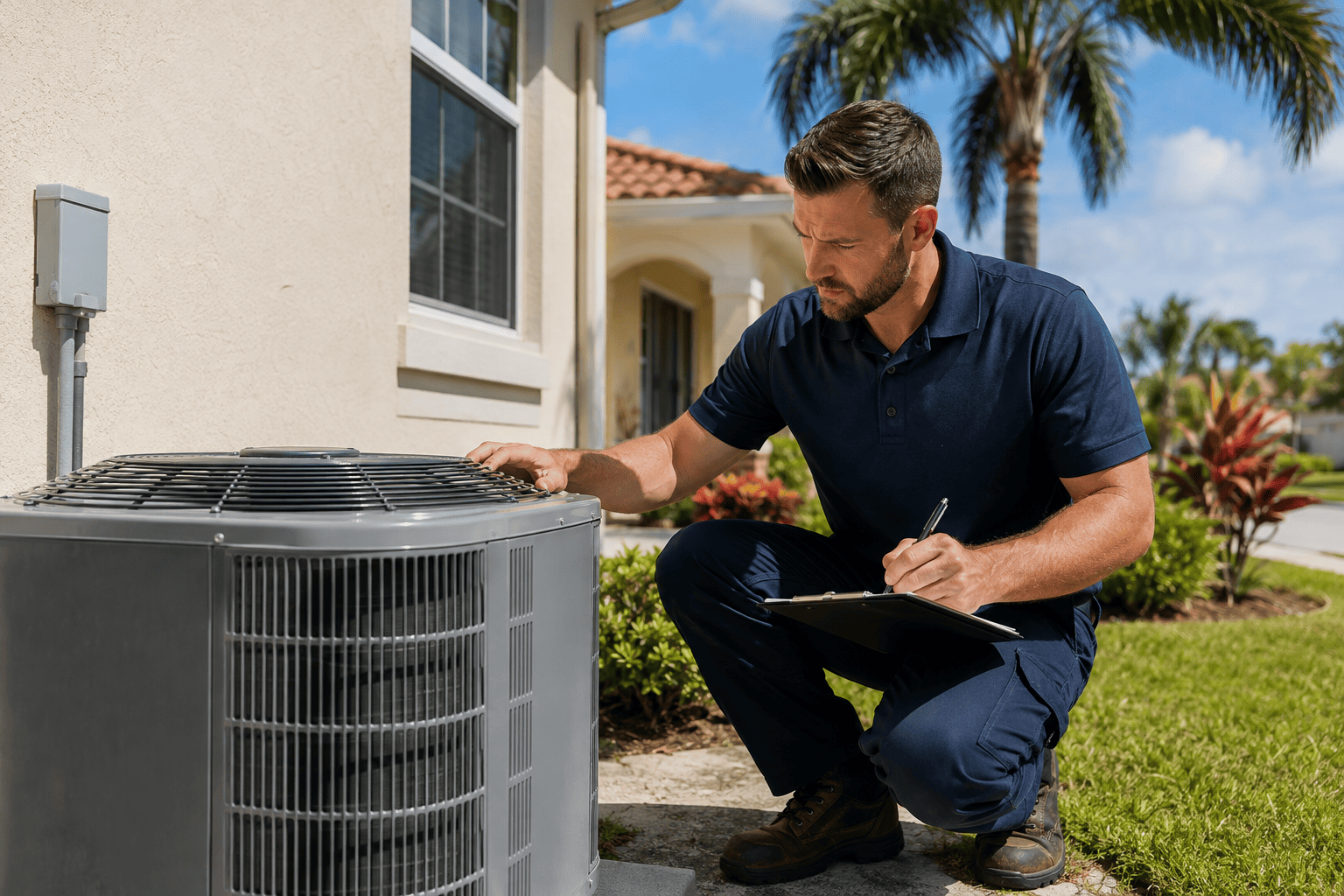
Your AC just went out again — third time this year — and you’re standing in front of it doing math in your head. Is this worth fixing, or is it time to just replace the whole system? In Boynton Beach, where your air conditioner runs nearly year-round, that decision hits your wallet either way. Here’s how to actually make the call.
Start With the Age of Your System
Most residential AC units in South Florida are built to last 10–15 years, but our heat and humidity push systems harder than they run in cooler climates, so many start struggling closer to the 10-year mark. If your unit is under 8 years old, repair is usually the smarter move. If it’s past 10–12 years, every repair is really just a temporary patch on a system that’s already on borrowed time.
The 50% Rule
A simple rule most HVAC pros use: if the repair cost is more than 50% of the cost of a new system, replace it. A $600 capacitor fix on a 6-year-old unit? Fix it. A $2,800 compressor replacement on a 13-year-old unit that’s already needed two other repairs this year? That money is better spent toward a new system with a full warranty.
Factor In R-410A Refrigerant Costs
If your system uses R-22 refrigerant (common in units installed before 2010), repairs involving a refrigerant leak have gotten significantly more expensive since R-22 was phased out. Even R-410A, the replacement refrigerant used in most systems installed over the past decade, is now facing its own phase-down under EPA regulations, which is starting to push repair costs up on older R-410A systems too. If your technician tells you your system needs a recharge on either refrigerant type, that’s often a sign the system is nearing the end of its practical lifespan.
SEER2 Efficiency: What You Gain by Replacing
New systems sold today meet SEER2 efficiency standards, which are noticeably stricter than what was required even five years ago. A system installed in 2012–2015 is likely running at 13–14 SEER. A new SEER2-rated system can cut your cooling costs by 20–30%, which adds up fast on your monthly FPL bill given how much South Florida homes rely on AC. That efficiency gap is often the deciding factor for homeowners on the fence — the monthly savings partially offset the cost of a new unit over time.
Don’t Forget Local Rebates
FPL periodically offers rebates for high-efficiency AC replacements through its energy efficiency programs, and manufacturers often run their own seasonal rebates too. Before you commit to another round of repairs, it’s worth asking what incentives currently apply — they can meaningfully close the price gap between “repair” and “replace.”
Quick Decision Checklist
- Unit is under 8 years old → Repair
- Unit is 8–12 years old, repair cost is under 50% of replacement → Repair
- Unit is over 10–12 years old, repair cost is over 50% of replacement → Replace
- System uses R-22 or needs a second refrigerant recharge → Replace
- You’ve had 2+ breakdowns in the past 12 months → Replace
- You’ve had 2+ breakdowns in the past 12 months → Replace
Get an Honest Recommendation
The truth is, the repair-vs-replace call depends on your specific unit, its history, and your budget — not a one-size-fits-all rule. Cold Chillin Air Conditioning gives Boynton Beach and Palm Beach County homeowners straight answers, not upsells. If you’re weighing your options, our team can walk you through what a new AC installation would actually cost and save you compared to continuing to repair your current system.
Call 561-318-1882 for a free, no-pressure assessment.