Replacing the AC in a condo or townhouse isn’t quite like replacing it in a single-family home. There’s an association to involve, the equipment may sit on a roof, a balcony or a shared mechanical area, and the air handler is often squeezed into a hall closet. With a little planning it goes smoothly. Without it, a two-day job can stretch into weeks.
Here’s what Boynton Beach and Palm Beach County condo owners should know before replacing their system.
Step 1: Check your association’s rules first
Most condo and HOA associations have rules about HVAC work. Before you schedule anything, ask your property manager or check your documents for:
- Approval forms. Many associations require an application before any equipment is replaced.
- Contractor requirements. Often a copy of the contractor’s state license and certificate of insurance, sometimes naming the association.
- Work hours and access. Permitted days and times, elevator reservations, loading areas and parking.
- Roof access. If the condenser is on the roof, the association usually controls the key and may require notice.
- Equipment placement. Rules on where condensers can sit and how line sets and drain lines can be run.
- Crane or lift requirements for some mid- and high-rise buildings.
Starting the paperwork early is the single best way to avoid delays, especially if your system is already failing in summer.
Step 2: Permits
In Florida, replacing an air conditioning system generally requires a mechanical permit from the local building department, pulled by a licensed contractor. Associations commonly ask to see it. A licensed contractor handles the permit and inspection as part of the job. Be wary of anyone who offers to skip the permit to save money; it can cause problems with insurance claims and when you sell.
Step 3: Understand your equipment
Closet air handlers
Many South Florida condos have a vertical air handler in a hall or utility closet. The new unit must physically fit the closet with room for service, the filter and the drain. Sometimes the closet opening, platform or return need small modifications.
Condensers on roofs, balconies or ground pads
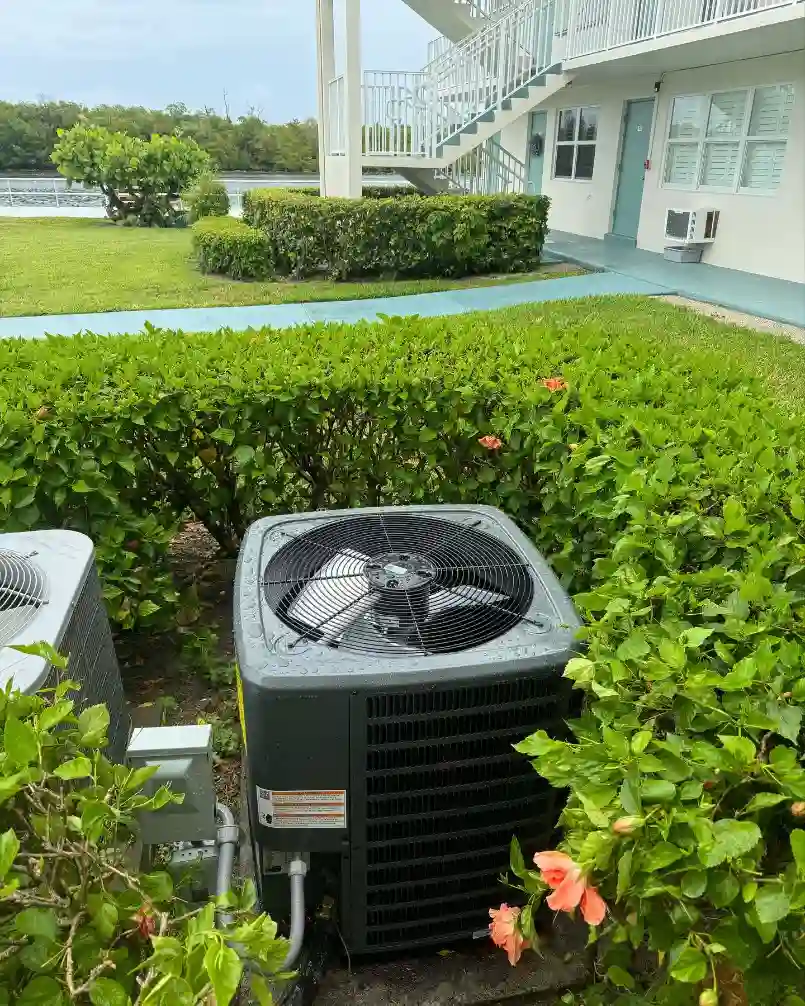
Where your condenser sits affects labor and scheduling. Roof units may need a crane or lift. Balcony units need care moving equipment through the unit. Ground-level pads are simplest.
Line sets
Refrigerant lines in condos often run through walls or chases you can’t easily replace. New systems use newer refrigerants (see the R-410A phase-out), and the existing line set needs to be checked for size and condition and properly cleaned or replaced as the manufacturer requires.
Drain lines
Condensate drains in condos often tie into shared building drains. A clogged condo drain can damage a neighbor’s ceiling, so a float switch and a clean, properly sloped drain are essential. See AC leaking water.
Sizing a condo system correctly
Condos are often over-sized because contractors simply match the old tonnage. An interior unit with neighbors on both sides may need less capacity than an end unit with west-facing glass. An oversized system short cycles and leaves the condo humid. We size with a load calculation; read how to size an AC for a Florida home.
Should you replace both parts at once?
Usually yes. Indoor and outdoor units are designed and rated as a matched pair. Mixing a new condenser with an old air handler can reduce efficiency, cause reliability problems and affect manufacturer warranty coverage. With the newer refrigerants used in today’s equipment, matched systems are generally required.
A typical condo replacement timeline
- Estimate and equipment selection, including measurements of the closet and condenser location.
- Association approval, which can take days or weeks depending on the board.
- Permit application by the contractor.
- Installation, often one day for a straightforward swap, longer for roof or crane jobs.
- Inspection by the building department and registration of the manufacturer warranty.
Installation time details are in how long AC installation takes.
Repair or replace in a condo?
The same rules apply as in a house: age, repair cost, refrigerant type and how often it’s failing. Because approvals take time in a condo, it’s worth planning a replacement before an old system fails outright in August. See AC repair vs. replacement and how long AC units last in Florida.
Frequently asked questions
Do I need association approval to replace my condo AC?
Many associations require it. Check your governing documents or ask your property manager before scheduling.
Who is responsible for the condo AC, me or the association?
In most Florida condos the owner is responsible for equipment serving only their unit, but your declaration is the final word. Check it before you buy.
Can a condo AC be replaced in one day?
A straightforward like-for-like replacement often can, once approvals and the permit are in place. Roof or crane jobs take longer to schedule.
Planning a condo AC replacement? Call Cold Chillin
We replace condo and townhouse systems across Boynton Beach, Delray Beach, Boca Raton, Highland Beach and the rest of Palm Beach County, and we can provide license and insurance documents for your association. Licensed (CAC 1823036). Call (561) 318-1882 or request a free estimate. More on our AC replacement service.